What Safety Equipment Should Every Office Have: 9 Essentials
Office emergencies like cardiac arrests, fires, and injuries can happen anywhere, and having the right safety equipment on hand is often the difference between a minor incident and a tragedy. This guide covers the 9 essential pieces of safety equipment every office should have in 2026, explaining what each item does, why it matters, and how to choose the best option for your workplace.
Office environments feel safe by design, but emergencies do not check the calendar before arriving. Cardiac arrests, severe cuts, fires, and slip-and-fall injuries happen in workplaces every year, and the difference between a minor incident and a tragedy often comes down to whether the right equipment was within reach.
OSHA requires employers to provide a safe working environment, and that obligation extends well beyond posting a fire escape route on the break room wall. Here are the essential pieces of safety equipment every office should stock, why each one matters, and what to look for when choosing them.
1. AED (Automated External Defibrillator)
Best for: Responding to sudden cardiac arrest in the workplace
360 Safety supplies workplace-ready AEDs along with training, compliance guidance, and ongoing support so offices are fully prepared for sudden cardiac arrest.
Where This Tool Shines
An AED is arguably the single most important piece of safety equipment an office can have. Sudden cardiac arrest can affect anyone, regardless of age or health history, and survival rates drop significantly with every minute that passes without defibrillation. AEDs are designed for layperson use, with clear audio and visual prompts that walk a responder through each step even under pressure.
What sets 360 Safety apart is that they do not just sell the device. They provide bundled CPR and AED familiarization training, help you navigate state AED placement laws, and send maintenance reminders so your unit stays inspection-ready. That full-service approach is especially valuable for office managers who do not have a dedicated safety coordinator on staff.
Key Features
Workplace-Ready AED Models: Clear audio and visual prompts guide untrained bystanders through the defibrillation process step by step.
Bundled Training: CPR and AED familiarization training is available alongside device purchase so your team is prepared from day one.
Compliance Support: Guidance on state AED placement laws helps offices meet legal requirements without having to research regulations independently.
Maintenance Reminders: Ongoing pad and battery replacement guidance keeps the device ready when it matters most.
Local Support: A team focused specifically on workplace safety, not a generic online retailer, backs every purchase.
Best For
Any office with more than a handful of employees should have an AED on site. It is particularly critical for offices in buildings where emergency medical services may take several minutes to arrive, multi-floor workplaces, and organizations with older employee populations or frequent visitors.
Pricing
Contact 360 Safety directly for pricing on AED units and training packages. Costs vary based on the model selected and whether training is bundled.
2. First Aid Only ANSI-Compliant First Aid Kit
Best for: Treating everyday office injuries including cuts, burns, and sprains
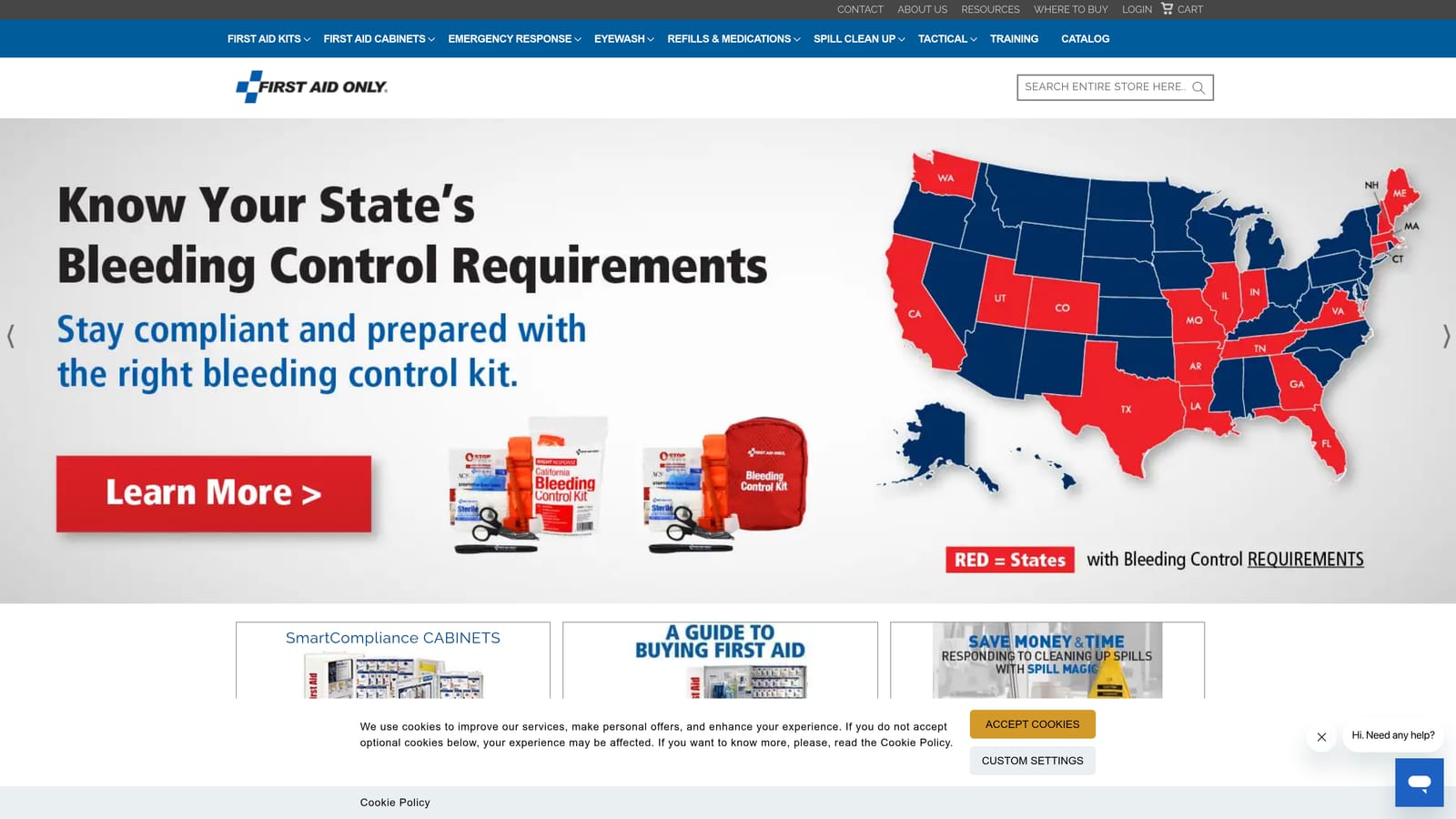
First Aid Only produces workplace first aid kits stocked to meet ANSI/ISEA Z308.1 standards, covering the most common office injuries from minor cuts and burns to sprains.
Where This Tool Shines
OSHA does not mandate a single specific kit, but it references ANSI/ISEA Z308.1 as the minimum standard for workplace first aid supplies. First Aid Only offers both Class A and Class B configurations, so you can match the kit to your office's actual risk profile rather than guessing. Class A covers the most common injury types, while Class B includes a broader range of supplies for higher-hazard environments.
The wall-mountable hard case is a practical detail that matters in a real emergency. When someone is bleeding, you do not want to be rummaging through a soft bag on a shelf. Clearly labeled compartments let any employee find what they need in seconds, not minutes.
Key Features
ANSI/ISEA Z308.1 Compliance: Class A and Class B configurations available to match your office's risk level and workforce size.
Wall-Mountable Hard Case: Designed for break rooms or hallways where visibility and fast access are essential.
Clearly Labeled Compartments: Organized layout allows any employee to locate supplies quickly without prior training.
Refill Packs: Available to keep kits stocked after use, so the kit stays ready rather than sitting empty after an incident.
Workforce Sizing: Kits are sized by headcount, making it straightforward to select the right option for your team.
Best For
Every office regardless of size. A small startup with ten employees needs a Class A kit at minimum. A larger office with multiple floors should have kits on each level, sized to the number of people working in each area.
Pricing
Starts around $30 for small kits. Larger ANSI Class B configurations are priced higher depending on contents and kit size.
3. NAR CAT Tourniquet (Bleeding Control Kit)
Best for: Controlling severe bleeding from traumatic injuries until emergency services arrive
North American Rescue produces the Combat Application Tourniquet, widely trusted by trauma professionals and recommended for workplace bleeding control kits.
Where This Tool Shines
Severe bleeding from a laceration, a fall through glass, or a workplace accident can become life-threatening within minutes. The Stop the Bleed campaign, promoted by the American College of Surgeons, has brought bleeding control training and equipment into schools, offices, and public spaces across the country. The CAT tourniquet is one of the most recommended tools in that program because it is designed for single-handed application, meaning an injured person can apply it to their own limb if no one else is immediately available.
The windlass rod locks securely once tightened, maintaining pressure without requiring the responder to hold it in place. That matters when you are managing a stressful scene and waiting for emergency services to arrive.
Key Features
Single-Handed Application: Designed so an injured person can apply it to themselves, not just rely on a bystander.
Locking Windlass Rod: Maintains pressure once tightened so the responder does not have to hold it continuously.
Compact Storage: Small enough to fit in a wall-mounted bleed kit alongside wound packing gauze and gloves.
Stop the Bleed Compatible: Widely used in Stop the Bleed training programs, so employees who take that course will already be familiar with it.
Kit Options: Available individually or as part of a full bleeding control kit with additional supplies.
Best For
Offices that want to go beyond a standard first aid kit, particularly those in buildings where emergency response times may be longer. Ideal when paired with Stop the Bleed training for staff.
Pricing
Approximately $30 to $35 pe